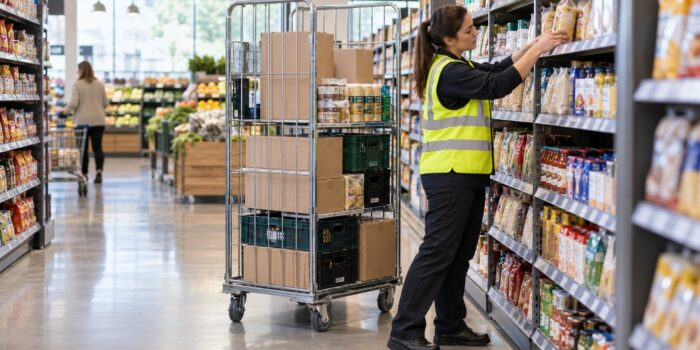
What Is a Supermarket Cage? Retail Replenishment and Shop Floor Use
Anyone who has stood near a supermarket loading bay before opening hours has seen them: rows of wire cages stacked with milk, bread, tinned goods, and multipacks, moving stock through the supply chain and into store as part of the back-of-house replenishment process. These are supermarket cages — sometimes called supermarket roll cages or supermarket cage trolleys — and they are one of the quietest but most essential pieces of equipment in UK retail supply chains.
What Is a Supermarket Cage?
A supermarket cage is a mobile, mesh-sided container mounted on castors, built to move goods from delivery vehicle to shelf without the stock ever being repacked by hand. Unlike a standard roll cage used in general warehousing, supermarket cages are sized and shelved specifically for retail replenishment: they slot through store doors, down aisles, and into stockrooms without needing a forklift or pallet truck.
Most units feature:
- A tubular steel frame with mesh or solid panel sides
- Two or more fixed shelves for split-tier loading
- Four swivel castors (often braked on at least two) for tight-aisle manoeuvring
- A drop-down or removable front gate for shelf-level access
- A nesting design so empty cages stack inside one another for the return trip
Why Retailers Depend on Cage-Based Replenishment
Supermarkets run on narrow delivery windows and tight labour budgets. Supermarket cages — used here as supermarket stock cages, holding pre-picked goods by aisle or category — solve a specific logistics problem: getting pre-picked stock from the distribution centre into store and through the back-of-house process quickly, reducing handling steps between goods-in and shelf.
Speed of replenishment. A single staff member can move a fully loaded cage through goods-in, into the stockroom, and use it to replenish shelves directly from the cage — cutting the time between goods-in and goods-on-shelf — the same principle covered in our piece on how the right dairy trolley speeds up store replenishment.
Reduced manual handling. Moving stock in a cage removes repeated lifting of individual boxes, which matters for injury prevention and for meeting manual handling regulations on the shop floor.
Stock control. Cages are often loaded and sealed at the distribution centre by product category or aisle, so what arrives at the store already matches how it will be shelved.
Space efficiency. Empty cages nest together, so a stockroom or yard can hold far more empty units in the same footprint than flat pallets would allow.
Supermarket Cages vs Standard Roll Cages
The two look similar at a glance, but the differences matter for anyone specifying a fleet (see our complete guide to types of roll cages for the full picture):
| Feature | Supermarket Cage | Standard Roll Cage |
| Shelving | Fixed, retail-height shelves | Often shelf-free or adjustable |
| Sides | Mesh, for stock visibility | Mesh or solid, general purpose |
| Use case | Shop floor replenishment | Warehouse, distribution, general transport |
| Load height | Lower, aisle-friendly | Can be taller for bulk warehouse use |
Retailers typically standardise on one cage type across their supply chain so that stock loaded at the distribution centre fits store layouts without adjustment.
Load Limits and Safe Handling
Supermarket cages are built to carry meaningful weight, but safe use depends on loading and moving them correctly, not just on the frame’s rated capacity (our guides on how to load a roll cage safely and top tips on roll cage safety cover this in more depth).
- Load within the rated limit. Most retail cages are rated in the region of 350–500kg gross, but the figure varies by manufacturer and frame condition — always check the plate on the unit rather than assuming.
- Load heavy items low. Keeping weight on the lower shelf keeps the cage’s centre of gravity down, which matters most when moving across ramps or uneven yard surfaces.
- Check castors before moving. A cage with a seized or damaged castor is far harder to control and is a common cause of tipping incidents.
- Never overload above the top rail. Stock stacked above the frame line is unstable and a manual handling risk during transit.
- Brake on ramps and slopes. Braked castors should be engaged whenever a loaded cage is left standing on anything other than level ground.
Keeping a Supermarket Cage Fleet Running
A cage fleet takes daily punishment — yard surfaces, ramp edges, overloading, and constant movement all take a toll on castors, mesh panels, and frames. Damaged cages are more than a maintenance headache: a cage with a bent frame or seized wheel is a manual handling risk on a shop floor.
This is where fleet repair and maintenance earns its keep. Rather than replacing damaged units outright, a scheduled repair programme with DM’s roll cage repair specialists keeps cages within safe working condition — straightened frames, replaced castors, repaired mesh — while extending the working life of the fleet and reducing capital spend on new units.
FAQs
What is a supermarket cage used for?
A supermarket cage moves pre-picked stock from the distribution centre into store, through goods-in and the stockroom, and enables staff to replenish shelves directly from the cage — reducing the number of times stock is handled between the DC and the shelf.
How much weight can a supermarket cage hold?
This depends on the frame and manufacturer, but most retail cages are rated in the range of 350–500kg. The exact limit is stated on the cage’s rating plate and should always be checked before loading.
What’s the difference between a supermarket cage and a roll cage?
A supermarket cage is a type of roll cage built specifically for retail use, with fixed shelving sized for shop-floor replenishment. General roll cages are used more broadly across warehousing and distribution.
Can supermarket cages be repaired instead of replaced?
Yes. Frames, castors, and mesh panels can usually be repaired or replaced individually, which is generally more cost-effective than buying new units, especially across a large fleet.
Why do supermarket cages have mesh sides?
Mesh sides let staff see the contents at a glance during replenishment and stock checks, and they keep the unit lightweight compared with solid panelling.
What causes most supermarket cage accidents?
Most incidents come down to overloading above the top rail, moving a cage with a damaged or seized castor, or failing to brake a loaded cage on a ramp or slope. Routine fleet inspection and repair significantly reduces these risks.