Protecting Perishables: The Role of Insulated Containers in Logistics
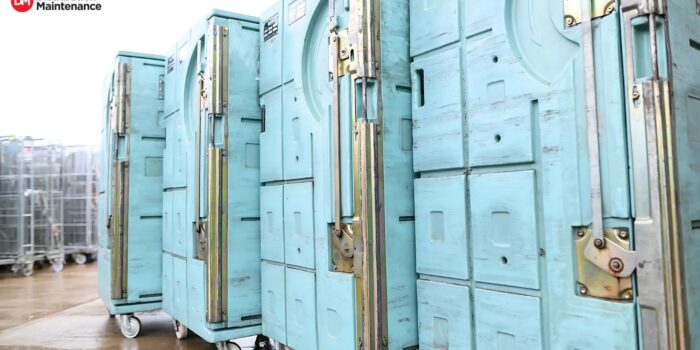
Insulated containers are temperature-controlled mobile units used in logistics to keep perishable goods — food, dairy, pharmaceuticals and medicines — at the correct temperature during transport. The most widely used type in UK distribution is the Thermotainer: a wheeled, insulated unit that can travel on a standard, non-refrigerated delivery vehicle alongside ambient goods.
Distribution Maintenance repairs, refurbishes and supplies Thermotainers from our 12,000 sq ft facility in Grantham. This guide covers how insulated containers work, why they are essential for cold chain compliance, and how to keep a fleet in serviceable condition.
What is an insulated container and how does it work?
An insulated container is a sealed, wheeled unit built from high-density polyethylene or stainless steel with a thick internal layer of polyurethane foam or expanded polypropylene insulation. The insulation acts as a thermal barrier — keeping cold air in and ambient heat out. Heavy-duty door gaskets and seals ensure no air escapes when the doors are closed, and high-quality castors allow staff to move fully loaded units with minimal effort.
Thermotainers are typically pre-cooled before loading using eutectic cooling plates, dry ice or a cold store environment. Once loaded and sealed, a correctly maintained unit holds temperature for several hours — enough for most UK delivery routes.
Why do logistics operations use insulated containers?
Logistics operations use insulated containers to transport temperature-sensitive goods on standard delivery vehicles, removing the need for a separate refrigerated lorry for every chilled or frozen load.
The main operational advantages are:
- Mixed-load flexibility — frozen items in one unit, chilled in another, both travelling on the same non-refrigerated vehicle alongside ambient goods
- Cost reduction — one vehicle and driver instead of two separate runs; lower fuel costs and fewer vehicle movements
- Route efficiency — the driver makes one stop instead of several, reducing time between goods-in and delivery
- Compliance — UK food safety regulations (FSA guidelines) require perishables to be held within defined temperature ranges throughout transit; a serviceable Thermotainer meets this requirement without a refrigerated vehicle
What temperature range do insulated containers maintain?
Insulated containers maintain temperature through passive insulation combined with eutectic plates, dry ice or pre-cooling — not active refrigeration. Performance depends on:
- The insulation thickness and condition of the unit
- The condition of the door seals and gaskets
- Whether the container was pre-cooled before loading
- Ambient temperature during transit
A well-maintained Thermotainer used with appropriate cooling media typically holds the required temperature (2°C–8°C for chilled pharmaceutical goods; 0°C–4°C for fresh food) for the duration of a standard UK delivery route.
What are the food safety and compliance requirements?
UK food businesses operating under the Food Standards Agency (FSA) guidelines and the Food Safety and Hygiene (England) Regulations 2013 are required to control temperatures throughout the supply chain. Perishable goods that are transported at incorrect temperatures are not legally fit for sale.
Insulated containers help businesses meet these requirements by:
- Maintaining required temperature ranges during transit without a refrigerated vehicle
- Providing a non-porous, bacteria-resistant interior surface that can be pressure-washed and sanitised
- Allowing separate temperature zones on a single vehicle (chilled and frozen in separate units)
How are insulated containers used in pharmaceutical logistics?
In pharmaceutical logistics, insulated containers protect temperature-sensitive medicines and vaccines that must stay within a narrow range — typically 2°C to 8°C. Moving outside this range, even briefly, can degrade the product and render it unsafe.
Thermotainers used in pharmaceutical distribution are often lockable, providing both temperature control and physical security during the final-mile delivery to hospitals and pharmacies. The sealed, non-porous interior meets the hygiene standards required for medical supply chains.
What are the most common Thermotainer faults and repairs?
The most common Thermotainer faults are:
| Fault | Effect | Repair |
|---|---|---|
| Torn or compressed door gasket | Cold air escapes; temperature rises | Gasket replacement |
| Broken or stiff door latch | Door will not seal fully | Latch mechanism repair or replacement |
| Cracked or damaged insulation | Loss of thermal performance | Insulation repair or panel replacement |
| Seized or worn castors | Unit difficult to move safely | Castor replacement |
| Dented or damaged shell | Structural integrity compromised | Panel repair or replacement |
A Thermotainer with a torn gasket is no longer an insulated container — it is a heavy, expensive box. Regular inspection of seals, latches and castors prevents minor faults from becoming costly failures.
At Distribution Maintenance, our engineers carry out all common Thermotainer repairs at our Grantham facility. We also offer on-site repair services for fleets where removing units from service is impractical.
Is it worth repairing or refurbishing a Thermotainer?
Repairing or refurbishing a Thermotainer is almost always more cost-effective than buying new, provided the core structure and insulation are sound.
Refurbishment at our Grantham facility includes:
- Full strip-down and inspection
- Replacement of seals, gaskets and door latches
- Castor replacement
- Shell repair and repainting (including company colours using our spray booth)
- Pressure-washing and sanitisation
A refurbished Thermotainer leaves our facility performing to the same standard as a new unit. It also extends the product’s working life, reducing the need for new manufacturing — a measurable contribution to your operation’s sustainability targets.
What are the best practices for using Thermotainers?
Pre-cool before loading. Placing warm product into a cold unit causes a temperature spike at the start of the journey. Pre-cooling the container in a cold store before loading eliminates this.
Check door seals weekly. A small tear in a gasket leads to significant temperature loss over a long journey. Seal checks take seconds and prevent costly stock spoilage.
Do not overfill. Air circulation around the product is what maintains an even temperature. An overfilled unit will have warm spots, particularly near the door.
Use enough coolant. Calculate the duration of the route and add a safety margin. Running out of cooling capacity at the end of a long journey is a common cause of compliance failures.
Inspect castors regularly. A seized castor on a heavy loaded unit is a manual handling hazard. Castor checks should be part of every pre-use inspection.
FAQ
What is a Thermotainer?
A Thermotainer is a brand name for an insulated container manufactured by Olivo, widely used in UK food and pharmaceutical distribution. The term is commonly used generically to refer to any wheeled insulated container used in temperature-controlled logistics. Distribution Maintenance repairs, refurbishes and supplies both Olivo Thermotainers and equivalent units from other manufacturers.
How long does a Thermotainer keep goods cold?
A correctly maintained Thermotainer used with appropriate cooling media (eutectic plates or dry ice) typically maintains the required temperature range for 6–12 hours, depending on ambient conditions and the unit’s insulation integrity. Damaged seals or insulation reduce this significantly.
Do you repair Thermotainers we already own?
Yes. We carry out all common repairs — seals, gaskets, latches, castors, shell damage and insulation — at our 12,000 sq ft Grantham facility. We also offer on-site repair services for large fleets.
Do you sell refurbished Thermotainers?
Yes. We supply both new and refurbished Olivo Thermotainers in 500L and 900L configurations. Refurbished units are stripped, inspected, repaired and tested before dispatch.
Can Thermotainers be used for pharmaceutical distribution?
Yes. Thermotainers provide stable temperature control within the 2°C–8°C range required for most pharmaceutical goods. They are lockable for security and made from non-porous materials that can be sanitised to medical hygiene standards.
What is the difference between a 500L and 900L Thermotainer?
The 500L unit is the standard size for most retail and food service distribution. The 900L unit carries a larger volume and is used where delivery frequency is lower or where loads require more capacity. Both are available new and refurbished from Distribution Maintenance.