What Are Cages on Wheels? Types, Load Limits and Safe Handling
A cage on wheels is a wheeled steel container used to move, store and transport goods across warehouses, distribution centres, retail stores and delivery vehicles. The term covers a wide range of equipment — from standard roll cages used in supermarket replenishment to heavy-duty security cages for high-value goods and specialist laundry cages for linen operations.
If you are trying to choose between the different types of wheeled cage, or you need to understand the load limits and safe handling requirements before deploying a fleet, this guide covers what you need to know.
What is a cage on wheels?
A cage on wheels — also called a roll cage, cage trolley, wheeled cage or rolling cage — is a rigid steel frame mounted on four castors. The frame has mesh or rod infill on some or all sides, a base, and a gate or door for loading and unloading. The castors allow a loaded cage to be moved by one person, keeping goods secure and contained throughout the journey from picking face to delivery point.
The design varies considerably between types. Some cages nest inside each other when empty to save space on the return journey. Others are fixed-frame for maximum rigidity under heavy loads. The right choice depends on what you are moving, how far, and how often.
Types of wheeled cage
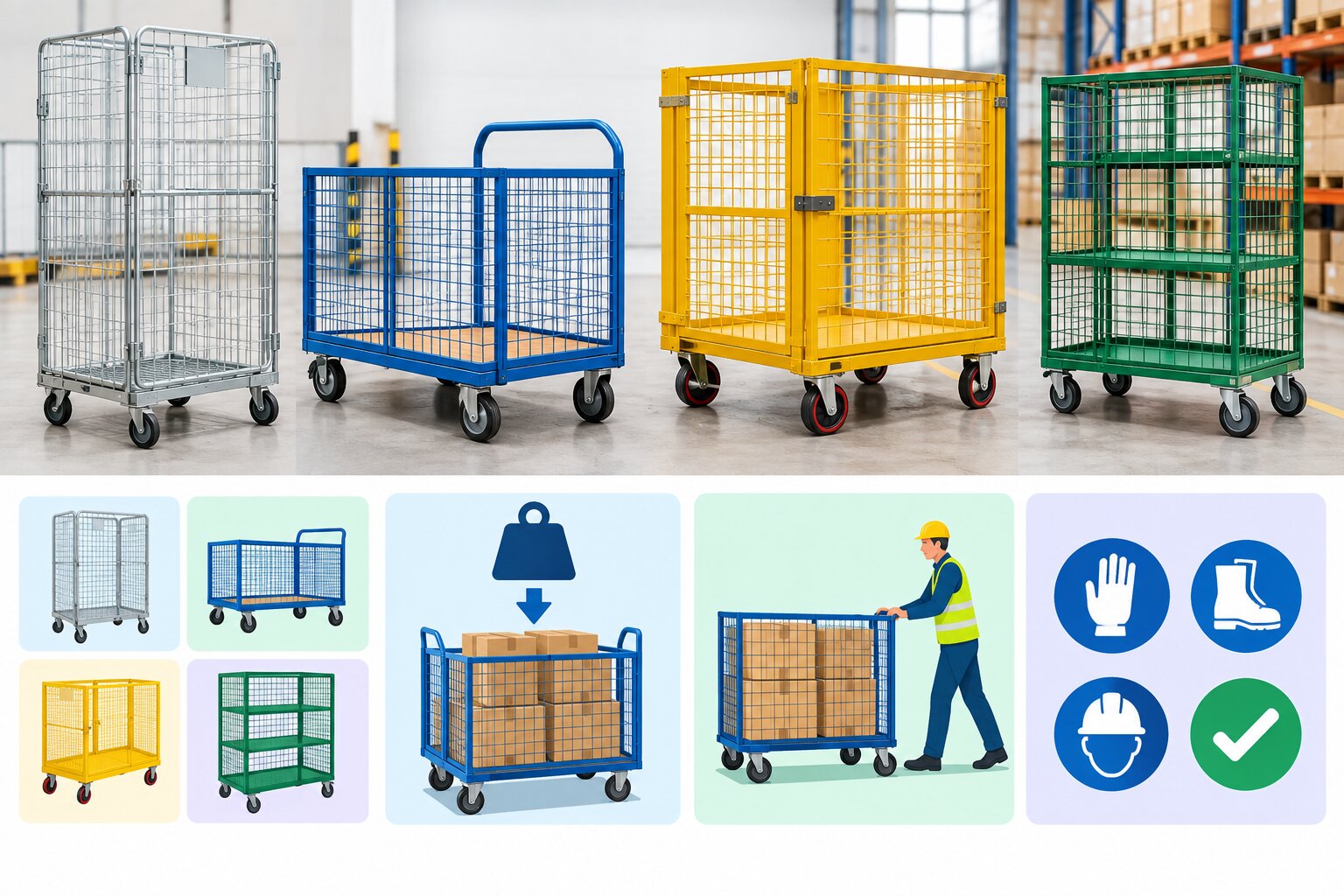
Roll cage (A-frame cage trolley)
The most common cage on wheels in UK retail and distribution. The A-frame refers to the shape of the base chassis — when the cage is empty, the side gates fold back and multiple units nest inside each other.
Available in several configurations:
- 2-sided — open front and back, used for quick-pick replenishment where speed matters more than security
- 3-sided — open front, used for most supermarket and wholesale distribution
- 4-sided — all sides enclosed with a locking front gate, used for high-value goods including alcohol, cosmetics and electronics
- Full Security – added product protection with an integral folding lid
Typical load capacity: 250–500kg depending on specification.
Standard dimensions: approximately 820mm wide x 720mm deep x 1,790mm high, though sizes vary by manufacturer.
Delivery cage
A delivery cage is a wheeled cage designed specifically for the final leg of distribution — from the vehicle to the store or customer. They tend to be lighter and more manoeuvrable than warehouse roll cages, with smooth-rolling castors suited to pavements and shop floors rather than just warehouse surfaces.
Delivery cages are widely used by food service distributors, parcel carriers and retail replenishment operations.
Security cage (full security roll cage)
Where standard roll cages leave the top or front open, a full security cage is completely enclosed — four mesh sides, a front gate with a lock, and an integral lid. The tight mesh infill prevents opportunistic theft even when the cage is left unattended on a loading bay or delivery vehicle.
Used for: alcohol, tobacco, electronics, cosmetics, pharmaceuticals and any goods with a high resale value.
Laundry cage
A specialist cage on wheels designed for linen handling in hotels, hospitals and industrial laundries. Key differences from a standard roll cage:
- Rod infill instead of mesh — smooth surface prevents snagging on delicate textiles
- Plastic or steel base — plastic bases run quieter and resist moisture from damp linen
- Part-height front gate with fixed lower panel — keeps loose linen inside even when the gate is open, preventing spills onto the floor
Cage trolley (nestable)
The term “cage trolley” is often used interchangeably with roll cage, but in many catalogues it refers specifically to a lighter, nestable unit designed for retail display and shop floor replenishment rather than heavy warehouse use. Load capacity is typically lower — 150–250kg — but the units take up less floor space when stored.
Storage cage on wheels
A storage cage on wheels is a fixed-frame welded cage, sometimes with a lockable door, used for secure storage of tools, equipment or parts within a warehouse or workshop. Unlike A-frame roll cages, these do not nest — they are built for permanence and security rather than logistics cycles.
Load limits — what you need to know
Every cage on wheels has a stated load capacity (sometimes called Safe Working Load or SWL). Overloading is one of the most common causes of cage failure, castor damage and workplace accidents.
Key points:
- The load capacity is the maximum weight of goods, not including the cage itself
- Weight should be distributed evenly — heavy items at the bottom, lighter items on top
- The stated load capacity assumes the cage is in good condition; a bent frame or seized castor reduces effective capacity
- For 3-sided and 2-sided cages, ensure the load is stable and will not shift when the gate is opened
Safe handling
Cages on wheels are one of the leading causes of manual handling injuries in UK warehouses and retail environments. The Health and Safety Executive (HSE) includes cage trolleys in its guidance on work-related musculoskeletal disorders.
Before moving a loaded cage
- Check all four castors roll freely — a seized castor dramatically increases the push force required
- Check the gate latch is secure so the load cannot shift during movement
- Ensure the load is within the stated capacity and is stable
- Confirm the floor surface is clear — debris under a castor causes sudden stops and awkward movements
When moving the cage
- Push, do not pull — pushing keeps the cage in front of you and reduces the risk of it running back
- Use a walking pace; do not run
- On slopes, maintain control at all times — a loaded cage on a ramp can accelerate quickly
- Use two people for cages loaded above 200kg, especially on slopes or over uneven surfaces
When loading
- Keep the heaviest items below knee height
- Never stack items above the top rail of the cage — they can fall when the gate is opened
- Distribute weight front-to-back and side-to-side evenly so the cage sits level on all four castors
Maintenance and inspection
A cage on wheels is safe and easy to handle when it is in good condition. The same cage with a bent frame, broken weld or seized castor becomes a hazard.
What to check regularly:
- Castors — spin freely, no flat spots, no debris jammed in the bearing
- Gates and hinges — open and close without forcing, latch engages fully
- Frame — no bent uprights, no cracked welds
- Mesh or rod infill — no broken wires that could catch hands or goods
For operations running large fleets, we recommend a formal inspection schedule. Our mobile engineers can carry out on-site repairs and inspections, or you can drop cages at our repair centres in Harlow or Grantham.
New, refurbished or rental?
New — best for standardising a new fleet or for applications where consistent specification matters (security, food, pharmaceutical). Every unit leaves the manufacturer to the same dimension and load rating.
Refurbished — cages that have been stripped, inspected and rebuilt with worn components replaced. The same functional performance as new at a lower price. Good for expanding an existing fleet or replacing specific units.
Rental (see our roll cage rental options) — removes capital outlay and maintenance responsibility. We hold a large fleet of uniform mesh retail cages available at short notice. Useful for peak season cover, short contracts or testing a new operation before committing to purchase.
Distribution Maintenance has been supplying, repairing and renting cages on wheels since 1982. We operate from two UK depots and carry out on-site and drop-off repairs nationwide.
Ready to upgrade your cage fleet? Whether you need a handful of units or a full national rollout, Distribution Maintenance has the stock, the repair expertise and the experience to help. Call 01279 883 286 or send an enquiry.
FAQ
What is the difference between a roll cage and a cage trolley?
The terms are often used interchangeably. “Roll cage” typically refers to the A-frame nestable unit used in retail and distribution. “Cage trolley” can mean the same thing, or in some catalogues refers specifically to lighter nestable units for shop floor use. Both are wheeled steel cages — the key difference is usually load capacity and frame construction.
How much weight can a cage on wheels hold?
It depends on the type and specification. Most standard A-frame cages have a static load rating of 500kg. Always check the stated Safe Working Load for the specific unit you are using.
Are cages on wheels safe to use on slopes?
Yes, with care. On any slope, maintain control of the cage at all times. Use two people for heavy loads. Ensure the floor surface is clear and that castors are in good condition before moving. A loaded cage on a ramp can accelerate if control is lost.
How often should cages on wheels be inspected?
There is no fixed legal requirement, but the HSE recommends regular inspection of work equipment under PUWER (Provision and Use of Work Equipment Regulations 1998). For high-intensity operations, a quarterly inspection of castors, gates and frame integrity is recommended. Any cage that develops a fault should be taken out of service until repaired.
Do you supply cages on wheels for laundry and linen operations?
Yes. We supply specialist laundry cage trolleys with rod infill, plastic or steel bases and part-height front gates. These are designed for hotel, hospital and industrial laundry environments where preventing snagging and maintaining hygiene are the priority.
Can you repair cages on wheels we already own?
Yes. We offer roll cage repairs, cage trolley repairs and associated equipment servicing at our facilities in Harlow and Grantham, and our mobile engineers attend sites across the UK. Common repairs include castor replacement, gate realignment and frame welding.