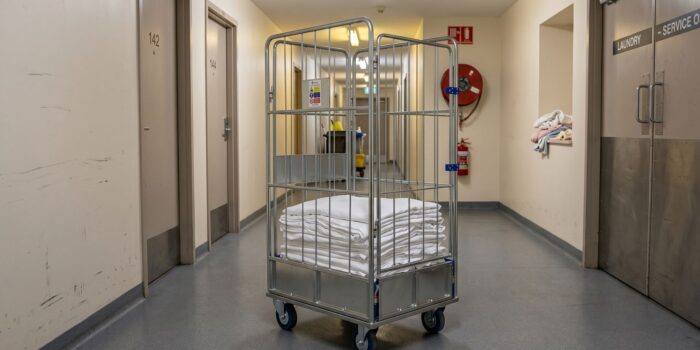
The Practical Guide to Efficient Linen Management: Why the Laundry Cage Trolley Matters
Moving hundreds of kilograms of soiled or clean linen across a hospital campus or through a hotel’s back-of-house corridors is a punishing job. It happens every day, often long before the first guest wakes or the first ward shift changes. If the equipment is sub-standard, the whole operation slows: bottlenecks, frustrated staff, damaged textiles. The laundry cage trolley is built specifically to prevent that, bridging the gap between the industrial wash cycle and the final delivery to the room or ward.
A laundry cage trolley is not a standard roll cage. Standard cages are designed for square boxes and stable crates; a linen trolley handles loose, shifting loads. It needs to carry heavy damp towels one hour and delicate pressed uniforms the next. At Distribution Maintenance we supply cages engineered for exactly those pressures, so your linen stays protected and your staff stay safe.
What makes a laundry cage trolley different from a standard roll cage?
Any trolley will move items from A to B. A dedicated laundry cage trolley includes design features that make it fit for purpose in high-turnover environments — features aimed at protecting the load and speeding up loading and unloading.
Intelligent product retention
The most common complaint with standard roll cages is the “linen avalanche”. Fill a full-height cage with loose towels or bedsheets and the pressure against the gate is immense. On many designs, opening the gate sends the bottom half of the load onto the floor — a hygiene risk and a waste of staff time.
Our laundry cage trolleys use a three-quarter height hinged front gate with a fixed lower section fitted with plastic retaining panels. Those panels form a permanent barrier that keeps the bulk of the linen inside the cage even with the main gate open. Staff reach over the fixed panel to access the contents, so the load stays contained and off the floor. For high-volume linen handling where speed matters but hygiene cannot slip, this makes a measurable difference.
Robust rod infill for textile safety
Textiles snag easily, and in a busy laundry cycle every snag costs. Traditional mesh infill works, but a broken wire can develop a sharp edge, and smaller items like pillowcases can poke through and catch in transit.
Our cages use robust rod infill instead of mesh. Solid rods are far more durable and far less likely to bend or warp under pressure. More to the point, the smooth rounded surface gives a snag-free environment. Even when high-quality linen presses firmly against the sides during a lorry journey, there is nothing for the fabric to catch on. That extends the life of your linen and keeps the equipment serviceable for years of heavy use.
Steel or plastic base?
The base carries the weight, and the right material depends on where the trolley works.
- Steel bases — maximum durability, and the standard for industrial laundries where cages get handled roughly by machinery and tail lifts.
- Plastic bases — increasingly popular in hotels and hospitals. Plastic runs quieter than metal, which matters in guest-facing areas, and it will not rust when moving damp towels from a spa or pool.
Sector-specific challenges
The basic design stays the same, but how a linen trolley gets used varies a lot between sectors.
Hospitality: the need for silence
In a hotel, linen logistics should be invisible. Guests do not want to be woken by metal wheels clattering on a hard floor at 6:00 AM, which makes castor choice the single most important decision.
For hotel linen trolleys we recommend high-quality rubber or “sandwich” castors. These absorb the vibration that causes noise, letting housekeeping move stock silently through corridors. A well-maintained cage with quiet wheels keeps room replenishment from ever registering with the guest.
Healthcare: strict hygiene standards
In a hospital, a laundry cage trolley is part of infection control, not just transport. Soiled linen has to move securely to stop bacteria spreading. Many of our healthcare clients use colour-coded cages or dedicated PVC covers to separate “dirty” and “clean” loads without ambiguity.
Because our cages are galvanised steel, they stand up to the aggressive chemical cleaners used for sanitisation. You can pressure-wash these units daily without degrading the frame, which keeps the equipment compliant with medical hygiene standards.
Industrial laundries: stability and strength
Commercial laundries handle thousands of units a week and the physical demands are high. Every time a cage goes onto a tail lift or crosses a warehouse floor, it has to stay stable and secure.
The rigid advantage
Some logistics equipment is built to nest. Our laundry cage trolleys are built rigid, and in a high-intensity laundry environment that is the better trade. With no folding hinges or moving base parts, the cage holds its structural integrity far longer. Fewer failure points means less chance of developing the wobble that affects nesting units after years of heavy use.
The rigid design is backed by balance. The wheels sit at each corner rather than tucked underneath or offset. That wider wheelbase gives significantly greater stability, particularly when the cage is fully loaded with damp, heavy textiles. Through a narrow corridor or onto a delivery vehicle, corner-mounted wheels keep it upright and easy to steer.
Ergonomics and workplace safety
Moving bulk laundry is physically demanding work with a real risk of repetitive strain and back injury. A laundry cage trolley is designed to reduce that risk.
Moving linen vertically cuts out the need to lift heavy bags off the floor. The height of the cage lets staff push at chest level, the safest position for the back. Fitted with smooth-rolling castors, the force needed to start the trolley moving is minimal — a cage carrying 500kg of damp towels can be handled by one person, provided the equipment is properly maintained.
Why buy new laundry cage trolleys
Plenty of logistics equipment works fine second-hand. The high-intensity nature of laundry management usually justifies new, and the payback comes through reduced downtime and lower long-term maintenance costs.
New units bring current engineering standards: uniform welds, precise gate alignment. That consistency matters when you run hundreds of units — knowing every cage behaves like the next simplifies staff training and removes mechanical surprises mid-shift. New galvanised finishes also give maximum protection against the damp of laundry rooms and spas, so the fleet stays rust-free and looks professional for longer.
We supply high-specification, brand-new laundry cage trolleys built for the punishing cycles of hospitality and healthcare. Starting with a fresh fleet sets a performance baseline and gets your operation running at full efficiency from day one.
Maintenance: protecting your investment
Even new equipment needs a care plan to survive daily use. In a laundry environment the biggest threat is invisible: lint. Fine fibres from drying machines work into castor bearings, mix with moisture, and form a paste that eventually seizes the wheels.
Our 12,000 sq ft repair centre in Grantham keeps these assets in condition. We focus on the common wear points of a laundry cage trolley:
- Castor servicing — clearing debris and lubricating bearings for silent, smooth movement
- Gate and latch alignment — keeping the split-gate system easy to operate so staff never have to force a stuck door
- Structural integrity — expert welding to restore original strength after tail lift or forklift damage
A professional maintenance programme protects the capital you put into the fleet. Simple regular checks stop small mechanical issues becoming safety hazards, and keep the trolleys a help to your team rather than a hindrance.
A reliable foundation for your linen operation
Linen management is a game of volume and speed, and your equipment cannot be the weak link. Good laundry cage trolleys protect your textiles, keep staff safe from injury, and keep back-of-house running without interruption.
We have supported the hospitality, healthcare and industrial laundry sectors since 1982. We understand the pressures of these industries and have the engineering expertise to match.
Is your laundry operation as efficient as it could be? Call 01279 883 286 or view our range of new laundry cage trolleys and request a quote.
FAQ section (add before the CTA)
What is a laundry cage trolley?
A laundry cage trolley is a wheeled steel cage designed specifically for moving bulk linen. Unlike a standard roll cage built for boxes and crates, it uses rod infill rather than mesh to prevent snagging, and a part-height gate with retaining panels to stop loose linen spilling when the gate is opened.
What is the difference between a laundry cage and a standard roll cage?
A standard roll cage is designed for stable, square loads. A laundry cage handles loose, shifting textiles. The main differences are rod infill instead of mesh (snag-free), plastic retaining panels in the lower section (no linen avalanche), and corner-mounted wheels for stability under heavy damp loads.
How much weight can a laundry cage trolley carry?
Our laundry cage trolleys handle loads up to around 500kg of damp textiles. With well-maintained castors, a fully loaded cage can still be moved comfortably by one person at chest height.
Should I choose a steel or plastic base?
Steel bases suit industrial laundries where cages are handled roughly by machinery and tail lifts. Plastic bases suit hotels and hospitals — they run quieter in guest-facing areas and will not rust when moving damp towels from spa or pool areas.
Are laundry cage trolleys suitable for hospitals?
Yes. Our cages are galvanised steel, so they withstand the aggressive chemical cleaners used for sanitisation and can be pressure-washed daily without degrading the frame. Many healthcare clients use colour-coded cages or PVC covers to separate clean and soiled loads for infection control.
Do you repair existing laundry cages?
Yes. Our 12,000 sq ft Grantham facility services castors, realigns gates and latches, and carries out structural welding to restore cages damaged by tail lifts or forklifts.