Rack Protection: Types of Rack Guards and Where to Fit Them
Most damage to pallet racking comes from forklift trucks. A single knock to an upright can weaken a whole bay, and repeated knocks add up. Rack protection puts a barrier between the truck and the racking, so the guard takes the impact instead of the structure. This guide explains the main types of rack protection, where they are needed and how to choose the right one.
Why rack protection matters
An upright is the part of the racking that carries the load down to the floor. When a forklift dents or bends it, the bay can lose much of its strength without looking badly damaged. During a racking inspection, that kind of damage is rated amber or red, which means repairs and, for red, offloading the bay straight away.
Rack protection helps in three ways:
- Fewer damaged uprights: the guard absorbs the knock, so the racking stays within limits
- Lower repair costs: replacing a guard is quicker and cheaper than replacing an upright and offloading a bay
- Safer aisles: brightly coloured guards make uprights and aisle ends easier for drivers to see
Types of rack protection
Different parts of the racking need different protection:
| Type | What it protects | Where it is used |
|---|---|---|
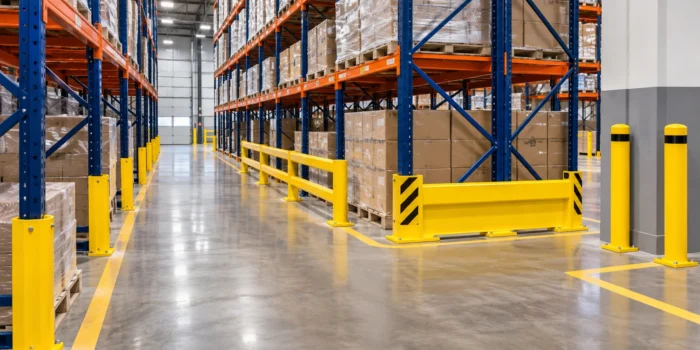
| Upright guards (column guards) | A single upright, from the front and sides | Along aisles, especially at the first bays |
| Rack end barriers | The whole end frame of a run | At the end of every aisle facing a vehicle route |
| Corner protectors | The exposed corner upright | Aisle corners and junctions where trucks turn |
| Guide rails | The base of the racking, by keeping trucks in line | Narrow and very narrow aisles |
| Column wraps and sleeves | Uprights from light knocks and scuffs | Low-speed areas and pedestrian zones |
| Back stops and anti-collapse mesh | Stops loads being pushed through or falling from the back | Back-to-back runs and racking beside walkways |
Where is rack protection needed?
The HSE guidance on warehousing and storage (HSG76) recommends protecting racking that could be struck by lift trucks. In most warehouses that means:
- Aisle ends and the corners of each run
- Junctions and cross-aisles where trucks turn
- Uprights next to loading bays, doorways and marshalling areas
- Any upright that already shows repeated impact damage
Your damage history is a good guide. If the same uprights keep appearing in inspection reports, they need protection, or better protection than they have now.
How to choose the right rack protection
- Steel or polymer: steel guards are rigid and suit heavy traffic; polymer guards flex and recover after light impacts
- Floor-fixed or upright-fitted: floor-fixed guards stand clear of the upright, so the impact is not passed into the racking
- Fit: guards must suit the size and profile of your uprights and leave room for pallets and trucks
- Visibility: yellow or yellow-and-black finishes make hazards easier to see
- Testing: ask whether the guard has been impact tested, for example to the European standard FEM 10.2.02
Rack protection and racking inspections
Rack protection does not replace inspections. A damaged guard should be recorded and replaced, and the upright behind it checked, because a guard that has taken a hit may not stop the next one. Use our racking inspection checklist for your weekly checks, and read our guide to pallet racking types, safety and repairs.
Rack guard protectors from Distribution Maintenance
Distribution Maintenance offers rack guard protectors, and inspects, repairs and installs warehouse racking across the UK. Our engineers work to SEIRS (Storage Equipment Installers Registration Scheme) standards. Find out more about our warehouse racking and rack guard services.
Rack protection FAQs
Is rack protection a legal requirement?
There is no single law that names rack guards, but employers must control the risks from work equipment under PUWER, and HSE guidance (HSG76) recommends protecting racking that could be struck by lift trucks. In practice, exposed uprights in vehicle routes should be protected.
Where should rack guards be fitted?
At aisle ends, corners, junctions and cross-aisles, and anywhere forklifts turn or work close to the racking, such as loading areas and doorways.
Are plastic or steel rack guards better?
Steel guards are rigid and suit heavy traffic. Polymer guards flex and recover after light knocks. The right choice depends on the trucks, speeds and space in each aisle.
Should a damaged rack guard be replaced?
Yes. A dented guard has already absorbed an impact and may not protect the upright from the next one. Replace it, and check the upright behind it for damage.
Does rack protection replace racking inspections?
No. Protection reduces damage, but racking still needs weekly visual checks and an expert inspection at least every 12 months.
Need rack protection fitted or damaged racking repaired? Contact us or call 01279 883 286.