How to Stack Pallets and Pallet Cages Safely: Height Limits and Rules
Pallets should be stacked on a firm, level floor, no higher than four times the narrowest side of the pallet, and usually no more than four loads high. That is the rule of thumb in the HSE’s warehouse guidance, HSG76. This guide explains the rules, shows the safe heights for UK and Euro pallets, and covers how to stack pallet cages safely.
Key takeaways
- The HSE says block stacks should generally be no more than 4:1, height to the narrowest side of the pallet
- Four loads high is the usual maximum. Up to six is possible only if the pallet and packaging are designed for it
- Never block stack crushable loads such as cartons. Use racking, a pallet cage or a pallet converter instead
- Pallet cages should only be stacked to the maker’s rating, and damaged cages should never be stacked
Last updated: 25 November 2026
How high can you stack pallets in a warehouse?
You can stack pallets in a warehouse up to a 4:1 ratio, meaning the stack is no more than four times as tall as the narrowest side of the pallet. The HSE also says four loads high is generally the maximum, because the goods on the bottom pallet can be crushed by the weight above.
This comes from paragraph 615 of HSG76, Warehousing and storage: A guide to health and safety (HSE, 2007). The HSE adds that taller stacks are possible in some cases, up to a maximum of six loads high, but only if the pallet and the packaging of the goods are designed to take more than four-high loading.
What is the 4:1 pallet stacking rule?
The 4:1 pallet stacking rule means the height of a block stack should not be more than four times the minimum depth or width of the pallet underneath it. A pallet that is 1,000mm on its narrowest side gives a maximum stack height of 4,000mm, provided the floor and loads are suitable.
The table below applies the HSE’s 4:1 ratio to the two most common pallet sizes in the UK. Treat these as upper limits, not targets. Your risk assessment may set a lower height for your loads, floor or equipment.
| Pallet size | Narrowest side | Maximum stack height at 4:1 |
|---|---|---|
| UK standard pallet (1,200 x 1,000mm) | 1,000mm | 4,000mm |
| Euro pallet (1,200 x 800mm) | 800mm | 3,200mm |
| Half pallet (800 x 600mm) | 600mm | 2,400mm |
Which loads should never be block stacked?
Loads that can be crushed, such as cartons and packs, should never be block stacked, because the strength and stability of the stack cannot be maintained. The HSE says these palletised loads should be stored another way, such as in pallet racking or inside a rigid frame that takes the weight instead of the goods.
A pallet cage or a pallet converter does this job. HSG76 describes a pallet converter as a frame that fits onto a wooden pallet so crushable or unevenly shaped loads can be stacked, and says it must stay rigid even when it is empty or only part loaded. Our guide to pallet cages explains how the different frames compare.
What makes a pallet stack unsafe?
A pallet stack becomes unsafe when the floor is uneven, the pallet is wrong for the load, the load is crushable or badly built, or the stack is too tall for its base. Damaged pallets, poor forklift handling and narrow gaps between rows also cause stacks to lean, collapse or be knocked over.
- Uneven or damaged floors. HSG76 says stacked loads should sit on a firm, level base.
- The wrong pallet. A pallet built for evenly spread loads, such as boxed cereals, may not be strong enough for a concentrated load of the same weight, the HSE notes.
- Damaged pallets. Broken deck boards and blocks weaken every load above them.
- No room between rows. The HSE asks for enough clearance between rows for safe stacking and withdrawal.
- Rough handling. Loads should be placed gently on the stack below, never dropped or pushed into place.
How do you stack pallets safely with a forklift?
Stack pallets safely with a forklift by keeping the mast vertical, entering the pallet squarely with level forks, and lowering each load gently onto the stack below. HSG76 also says pallets should not be pushed or pulled along the ground, and that forks should be spaced correctly for the pallet being lifted.
- Check the floor, the pallet and the load before you lift.
- Set the forks to the right width for the pallet.
- Enter the pallet squarely, with the mast vertical and the forks level.
- Lift with the pallet against the heel of the forks.
- Lower the load gently and squarely onto the stack below.
- Step back and check the stack is straight and stable.
Only trained and authorised operators should stack loads. HSE’s warehousing and storage pages cover lift truck safety in more detail.
How high can you stack pallet cages?
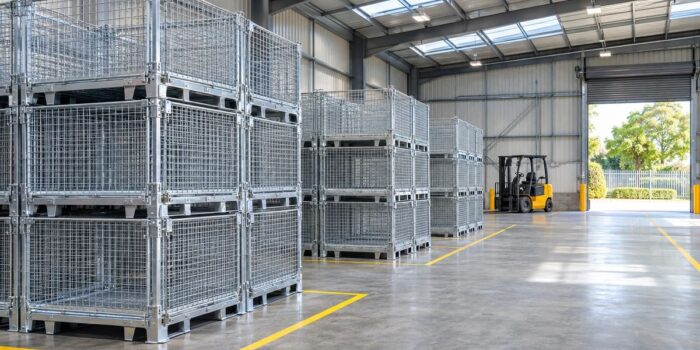
You can stack pallet cages only as high as the manufacturer’s stacking rating allows, and only when every cage in the stack is undamaged and loaded within its capacity. Stacking feet must locate properly in the cage below, and the heaviest cages should go at the bottom of the stack.
Collapsible pallet cages, such as our folding wire pallet cages, also fold flat when empty, which saves floor space between uses. Our new folding wire pallet cage is rated for 800kg and the refurbished heavy duty pallet cage for 1,500kg, so check which rating applies before you stack loaded cages.
- Check the stacking feet and corner posts are straight before every stack.
- Never mix cage sizes or makes in one stack.
- Do not stack a cage with a bent base, broken weld or damaged gate.
- Take damaged cages out of use and have them repaired or replaced.
How often should you check pallet stacks?
Pallet stacks should be checked regularly for leaning, crushed bottom loads and damage, and put right straight away when a problem is found. The HSE asks employers to check stacks periodically for stability, and to take corrective action where needed, as part of the site’s normal inspection routine.
If your site also uses pallet racking, our racking inspection guide explains the weekly and annual checks, and our rack protection guide covers guards that stop forklift damage.
Frequently asked questions
Is there a legal limit on how high you can stack pallets in the UK?
There is no single fixed height written into UK law. Employers must manage the risk, and the HSE’s HSG76 guidance sets the benchmark: block stacks generally no taller than 4:1 against the narrowest side of the pallet, and usually no more than four loads high. Your risk assessment can set a lower limit.
How many pallets high can you stack?
The HSE says four loads high should generally be the maximum for block stacking, because goods on the bottom pallet can be crushed. Up to six loads high may be possible, but only when both the pallet and the packaging of the goods are designed to take more than four-high loading.
How high can you stack empty pallets?
Empty pallets should still be stacked on a firm, level floor in straight, stable piles that cannot topple or be knocked over. Keep stacks clear of walkways, sprinklers and lights, and set a maximum height in your risk assessment. Damaged empty pallets should be taken out of use, not stacked.
Can you stack cartons on pallets?
You can store cartons on pallets, but palletised loads of cartons that can be crushed should not be block stacked on top of each other. The HSE says the strength and stability of such stacks cannot be maintained. Use pallet racking, a pallet cage or a pallet converter instead.
Do pallet cages make stacking safer?
Yes, when they are used correctly. A rigid pallet cage carries the weight of the cage above, so the goods inside are not crushed, and the frame keeps loose items contained. Pallet cages must be stacked only to the maker’s rating and checked for damage before every use.
Who is responsible for safe pallet stacking?
The employer is responsible for safe stacking, including the risk assessment, training and supervision. Staff who stack loads should be trained and authorised, and anyone who sees a leaning, crushed or damaged stack should report it at once so it can be made safe.
Sources
- HSE (2007) HSG76 Warehousing and storage: A guide to health and safety, paragraphs 610, 614 to 616, 619 and 628
- HSE: Warehousing and storage
- HSE: Provision and Use of Work Equipment Regulations 1998 (PUWER)
Need pallet cages for safe stacking? Browse our new pallet cages and refurbished pallet cages, or call 01279 883 286 for a quote.