What Is a Storage Pallet? Metal, Plastic and Collapsible Types Compared
A storage pallet is a flat or sided platform used to hold, stack and transport goods in warehouses, distribution centres and retail operations. The term covers a range of equipment — from basic flat platforms to collapsible wire pallet cages with drop-down front gates — and the right choice depends on the load, the handling equipment available and whether the pallet needs to contain its contents as well as support them.
What types of storage pallet are available?
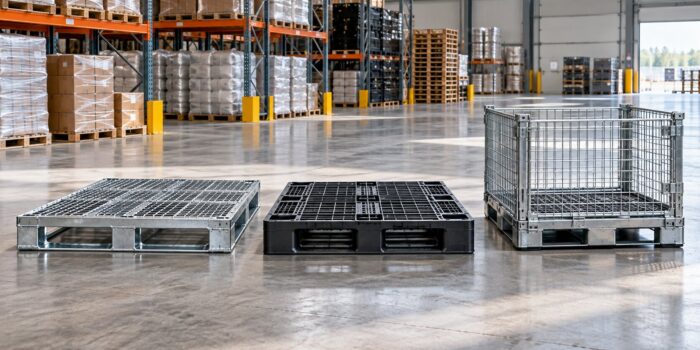
Storage pallets fall into three main categories based on material and whether they have sides:
Flat pallets — a platform with no sides, used with a forklift or pallet truck. Goods are stacked directly on the surface and secured with wrap or strapping. Standard UK dimensions are 1200mm x 1000mm.
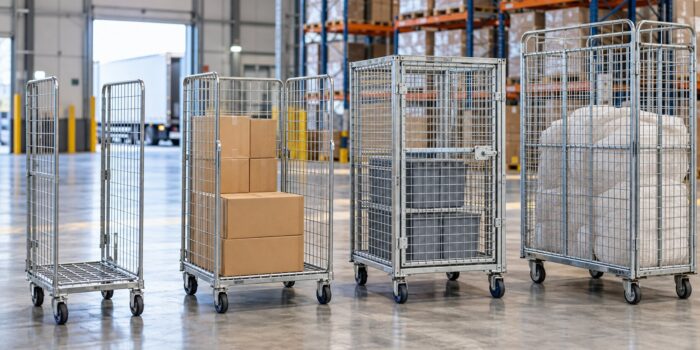
Pallet cages — a flat base with wire mesh sides and a drop-down or hinged front gate. The sides contain the load without the need for wrapping and allow visual inspection of contents without unstacking. Used where goods need to be secured during transit or where loose items would fall off a flat pallet.
Post pallets — a flat base with corner posts rather than solid sides, allowing pallets to be stacked vertically. Used for heavy items where full mesh sides are not required.
Distribution Maintenance supplies metal pallet cages (new and refurbished) and plastic pallets (refurbished). The sections below cover both in detail.
What is a metal pallet cage?
A metal pallet cage is a collapsible wire mesh storage unit with a steel base, mesh sides and a half drop-down front gate for access. It is designed to hold, stack and transport loose or irregular goods that cannot be safely palletised on a flat pallet.
Distribution Maintenance supplies new fully collapsible, corrosion-resistant bright zinc plated stackable pallet cages with a half drop-down front gate for easier access and better storage.
Key features of our new metal pallet cages:
- Collapsible — sides fold down flat when empty, significantly reducing space on return journeys and in storage
- Stackable — filled cages stack on top of each other, using vertical warehouse space efficiently
- Zinc plated — corrosion-resistant finish for long service life in warehouse and outdoor environments
- Half drop-down front gate — lower half drops for forklift access or picking; upper half retains the load
- Wire mesh sides — goods are visible from outside without opening the cage, speeding up stock checks
Refurbished metal pallet cages — fully refurbished heavy duty folding pallet cages, collapsible and stackable for transportation of goods — are also available from our used equipment page.
What is a plastic pallet?
A plastic pallet is a flat storage platform made from high-density polyethylene (HDPE) or similar polymer, used in the same applications as a wooden pallet but with several practical advantages.
Distribution Maintenance supplies refurbished plastic pallets — used, robust and versatile units suitable for a wide range of uses.
Why plastic over wood:
- Hygiene — plastic is non-porous and can be pressure-washed; wood absorbs moisture and can harbour bacteria, making it unsuitable for food, pharmaceutical and healthcare environments
- No ISPM 15 requirement — under ISPM 15 (UK government guidance), wooden pallets used in international shipments must be heat-treated or fumigated; plastic pallets are exempt, simplifying cross-border logistics
- Consistent dimensions — plastic pallets do not warp, split or lose shape over time, maintaining consistent stack heights and forklift entry points
- No splinters or nails — a flat, clean surface reduces the risk of product damage and injury during manual handling
Where plastic pallets are not the right choice: Plastic pallets have a lower load capacity than steel in most configurations and are not suitable for very heavy loads. They are more expensive to buy new than wooden pallets, though longer working life and lower maintenance cost frequently offset this over time.
Metal pallet cage vs flat pallet: which do you need?
The decision between a pallet cage and a flat pallet comes down to whether the load needs to be contained:
| Factor | Metal pallet cage | Flat pallet |
|---|---|---|
| Load type | Loose, irregular or fragile goods | Stable, stackable boxes or cartons |
| Sides required | Yes — goods would fall off a flat pallet | No |
| Visual inspection | Through mesh without unstacking | Must unstack or unwrap |
| Forklift compatible | Yes — via half drop-down gate or base channels | Yes |
| Empty storage | Collapses flat | Stacks as-is |
| Security | Higher — sides contain load | Lower — load exposed |
A common application for metal pallet cages is automotive components, metal parts, produce and other goods that are too irregular in shape to palletise safely on a flat platform.
Metal pallet cage vs plastic pallet: which do you need?
These serve different purposes. A metal pallet cage is a sided container — the right choice where goods need to be contained and the load is loose or irregular. A plastic pallet is a flat platform — the right choice where goods are already in boxes or cartons that stack stably and hygiene or international shipping requirements make wood unsuitable.
For food production, pharmaceutical manufacturing and healthcare, plastic pallets are the standard choice: non-porous, pressure-washable and ISPM 15-exempt. For distribution of loose goods, produce or returns, a metal pallet cage provides containment that a flat pallet cannot.
What accessories are available for metal pallet cages?
Distribution Maintenance offers a wide range of accessory options for pallet cages:
- Engraved name plates — stamped or sticker name plates to identify your pallet cages and stop them being taken by third-party companies
- Company colour spraying — we can spray the top corners of your pallet cages to your company colour requirements to identify them and minimise loss
New or refurbished storage pallets?
New metal pallet cages are available when you need consistent specification across a new fleet — same dimensions, same load rating, same gate configuration on every unit. New cages also carry a known service history from day one.
Refurbished metal pallet cages have been inspected, repaired and rebuilt to working standard. They are the cost-effective option for expanding an existing fleet or replacing worn units. Distribution Maintenance refurbishes pallet cages at our Grantham facility, with every unit checked before dispatch.
Refurbished plastic pallets are available when you need a hygiene-compliant, ISPM 15-exempt platform at lower cost than new. Each unit is inspected before dispatch.
FAQ
What is the difference between a pallet cage and a flat pallet?
A flat pallet is an open platform with no sides — goods are stacked on it and secured with wrap or strapping. A pallet cage has wire mesh sides and a drop-down front gate, containing the load without wrapping and allowing visual inspection without unstacking. Pallet cages are used where goods are loose, irregular or need to be secured during transit.
Are your metal pallet cages stackable?
Yes. Our new metal pallet cages are designed to be stacked when full, using vertical warehouse space efficiently. When empty, they collapse flat for return journeys and storage.
What size are your metal pallet cages?
Contact us to confirm current stock dimensions and specifications before ordering.
Why are plastic pallets better than wooden pallets for food and pharmaceutical use?
Plastic pallets are non-porous — they do not absorb moisture, bacteria or odours the way wood does. They can be pressure-washed and sanitised. They do not require ISPM 15 treatment for international shipment. They do not warp, split or shed splinters. For these reasons, food, pharmaceutical and healthcare operations typically specify plastic.
Do you supply new plastic pallets?
Currently we supply refurbished plastic pallets. Contact us on 01279 883 286 to confirm current availability and pricing.
Can you repair or refurbish pallet cages we already own?
Yes. We carry out pallet cage repairs at our facilities in Harlow and Grantham, and our mobile engineers attend sites across the UK. Contact us to discuss the repair scope and turnaround time for your fleet.