Shrinkage on the Move: Protecting High-Value Stock with Full Security A-Frame Cages
Inventory shrinkage is a quiet but persistent drain on retail and logistics profitability. Most businesses invest heavily in static security — CCTV, guards, alarm systems — inside the main warehouse. But stock is at its most vulnerable when it moves. The transition between the secure storage zone, the loading bay and the delivery vehicle is a high-risk window for opportunist theft, and standard open-sided pallets or loose boxes simply do not offer enough protection.
This is why more logistics operations are turning to security roll cages as a first line of defence. By enclosing high-value items in a lockable, heavy-duty steel structure while they are on the move, companies cut stock loss, protect margins and tighten up the whole distribution process.
Alcohol, high-end electronics, cosmetics and pharmaceuticals are the primary targets for transit theft. These items are small enough to conceal, hard to track once separated from their packaging, and easy to resell. A single missing crate of premium spirits or a misplaced box of smartphones can wipe out the profit margin on an entire delivery run. Securing these product lines needs a specific approach to mobile containment — one that deters theft without slowing your warehouse team down.
What is shrinkage in a retail store?
Shrinkage is the difference between the stock a business records on paper and the stock it actually has on the shelf or in the warehouse. In UK retail it typically comes from four sources: shoplifting, employee theft, supplier fraud, and administrative error.
Transit shrinkage is the portion that happens while goods move between locations — from the picking face to the loading bay, on the vehicle, or at the point of delivery. It is often the hardest type to detect, because losses are only discovered when stock is counted days later, long after the opportunity to identify who handled the goods has passed. Anti theft roll cages address this directly by creating a sealed, tamper-evident unit from the moment stock is picked.
The anatomy of deterrence: mesh infill and locking lids
Security is really about increasing the time and effort a theft takes. If an opportunist can grab an item in seconds without being noticed, shrinkage climbs. The design of a full security roll cage is built around total physical denial.
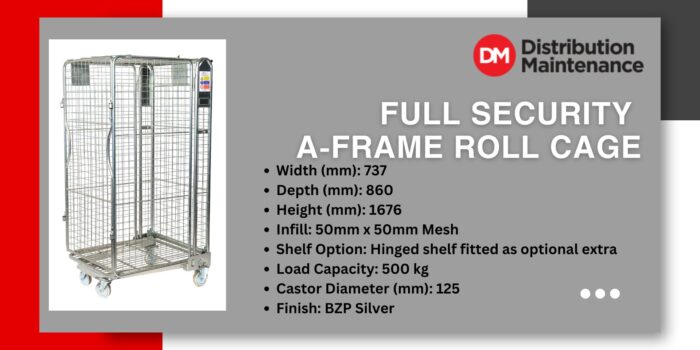
Unlike standard two-sided or three-sided roll cages that leave the front or top open for quick picking, a full security unit is completely enclosed. Sides, back, front doors and lid are all built with high-density steel mesh infill. The mesh pattern is tight enough to stop anyone reaching a hand through to pull out smaller items — perfume bottles, electronic accessories, cartons of cigarettes. Leave the cage unattended on a busy loading bay for a few minutes and the stock inside stays completely inaccessible.
The integral locking lid is the other feature that sets a lockable roll cage apart. In standard warehouse transport, a common point of loss is the top of the load. Items get lifted from the upper layers during loading or transit — a tactic that is difficult to spot on camera until long after the vehicle has left. A heavy-duty steel lid completes the secure box structure. With the front gates closed and the lid secured, the container becomes a mobile vault. Locking mechanisms take heavy-duty padlocks or security seals, so transport managers can run strict tamper-evident protocols from the moment the cage is packed to the moment it arrives.
Eliminating vulnerabilities on the loading bay
The loading bay is the most chaotic zone in any distribution centre. Vehicles arriving and departing, forklifts moving at speed, staff focused on tight delivery windows — an environment built for distraction. It is during these periods that high-value stock is most often left exposed. A pallet of cosmetics sitting on a bay waiting for a tail lift is a soft target.
Security roll cages change that dynamic. Instead of leaving loose boxes on an open pallet, items are picked directly into the secure cage inside the main warehouse. Once full, the doors are locked and sealed before the cage ever reaches the loading bay. Even if it sits on the dock for an hour because of a transport delay, the inventory is protected. An opportunist walking past cannot snatch a box from the stack — they would need to break a heavy lock or cut reinforced steel mesh, which takes time, makes noise and draws attention.
The enclosed design also helps with internal shrinkage. In large operations, tracking exactly who handles which product is difficult. Sealing the cage at the point of origin restricts access to high-value items to a small number of authorised staff. The cage stays locked until it reaches the receiver at the store or secondary hub, creating a clear, unbroken chain of custody.
Protecting stock during transit
Risk does not disappear once the lorry doors shut. Transit introduces its own problems. Vehicles make multiple stops on a single route, so the rear doors open in various locations — some with nothing like the security of a main distribution hub.
When a driver opens the back of a vehicle to deliver standard stock to a supermarket, any high-value items still on board are exposed to anyone near the delivery bay. Housed in a secure roll cage trolley, those items stay safe even with the lorry doors wide open in a public area. The driver can focus on unloading the goods for that stop instead of monitoring the rest of the payload.
The rigid structure protects stock from damage too. Rough roads, sudden braking and sharp turns cause loose cardboard boxes to fall and split. When a box of expensive alcohol falls and breaks, that is not just a loss through damage — it creates a situation where inventory goes missing or gets written off inaccurately. The steel frame and secure gates keep the load contained and everything arrives in saleable condition.
Operational efficiency: the A-frame design
A security solution is only worth having if it fits into a fast-moving operation without creating a bottleneck. If a container is too heavy, awkward to move or difficult to store, staff will avoid using it — and you get compliance problems instead of security.
The A-frame design balances protection with practicality. The term refers to the shape of the base chassis. When the cage is empty, internal shelves fold up and the side gates fold back, letting units nest tightly inside one another. For reverse logistics and warehouse space management this matters: instead of empty cages eating floor space or lorry capacity on the return journey, several nested units slide into the space one upright cage would take.
When full, the rigid construction gives excellent stability. The wheels are positioned so the cage turns and steers with minimal effort even at maximum load — essential for keeping flow on the warehouse floor, and for moving heavy loads without risking manual handling injuries.
New and refurbished security cages
Every distribution network runs on a different scale and budget. We supply high-specification, brand-new security cages with durable zinc plating and robust locking mechanisms. Starting with a new fleet lets you standardise your high-value transit protocols across the whole network.
Industrial equipment takes a beating, though — and a security cage is only secure if every component works. A bent gate, a compromised latch or a damaged mesh panel creates the exact vulnerability the cage is meant to close.
Our 12,000 sq ft repair facility in Grantham maintains and restores security fleets. Our engineers straighten frames, repair broken welds and replace worn castors. We can also use our spray booth to paint your fleet in a highly visible company colour. That colour-coding makes high-value transit assets instantly recognisable, helps staff identify which units need special handling, and acts as an extra deterrent against equipment loss.
Securing your bottom line
Shrinkage should not be accepted as an inevitable cost of doing business. Identify the points in your supply chain where stock is most vulnerable, put the right physical barriers in place, and you protect both your inventory and your profit.
Security roll cages are a practical, durable answer to transit theft. They turn open, vulnerable merchandise into a locked payload that moves safely through the most chaotic transport environments — from the tight mesh infill that stops opportunistic pilfering to the A-frame structure that saves warehouse space.
With over four decades supporting the UK logistics sector, Distribution Maintenance has the stock, the facilities and the expertise to upgrade your security infrastructure. Whether you need brand-new units to secure a new contract or professional repairs to bring your current fleet back to full strength, we can help.
Ready to cut transit shrinkage from your supply chain? Contact Distribution Maintenance on 01279 883 286 to explore our range of security roll cages and request a tailored quote.
FAQs
What is shrinkage in a retail store?
Shrinkage is the gap between recorded stock and actual stock. It comes from shoplifting, employee theft, supplier fraud and administrative error. Transit shrinkage — loss that happens while goods move between locations — is the hardest type to detect, because it usually surfaces at the next stock count rather than at the moment it occurs.
What is a security roll cage?
A security roll cage is a fully enclosed roll container with high-density steel mesh on all sides, front doors and an integral locking lid. Unlike a standard two- or three-sided cage, there is no open face, so stock cannot be reached or lifted out while the cage is in transit or waiting on a loading bay.
How do security roll cages reduce stock loss?
They remove the opportunity. Items are picked directly into the cage inside the warehouse, then locked and sealed before the cage reaches the loading bay. Reaching through the mesh is impossible, and getting in requires breaking a padlock or cutting steel — which takes time, makes noise and attracts attention.
What type of lock do security roll cages take?
The locking mechanisms accept heavy-duty padlocks or single-use security seals, so you can run tamper-evident protocols from the point of packing through to delivery.
Can security cages be nested to save space?
Yes. The A-frame base lets empty cages nest inside one another once the internal shelves are folded up and the side gates folded back. Several nested units fit into the space one upright cage would occupy, which matters on return journeys and in tight warehouse storage.
Do you supply refurbished security roll cages?
Yes. We supply both new and refurbished units, and our 12,000 sq ft Grantham facility repairs existing fleets — straightening frames, repairing welds, replacing castors and repainting cages in your company colour.