What Are Storage Cages on Wheels? Types, Uses and Benefits
Storage cages on wheels are wheeled steel containers used to move, store and transport goods across warehouses, distribution centres, retail stockrooms and industrial facilities. The wheels allow a fully loaded cage to be moved by one person, removing the need for a forklift or pallet truck for most internal logistics tasks.
Distribution Maintenance supplies new and refurbished storage cages on wheels from two UK depots — Harlow, Essex and Grantham, Lincolnshire — with nationwide delivery or collection available.
What is a storage cage on wheels?
A storage cage on wheels is a rigid steel frame mounted on four castors, with mesh or rod infill on some or all sides, a base and a gate or door for loading and unloading. Unlike a fixed shelving unit or static pallet cage, a wheeled storage cage can be moved with its contents — from the picking face to the delivery vehicle, from the stockroom to the shop floor, or from one area of a warehouse to another — without repacking or restacking.
The design varies significantly between types. Some nest inside each other when empty to save space on return journeys. Others are fixed-frame for maximum rigidity under heavy loads. Sizes range from compact nestable cage trolleys for retail replenishment to large secure cages for high-value goods.
What types of storage cage on wheels are available?
A-frame roll cage (nestable)
The most widely used storage cage on wheels in UK retail and distribution. The A-frame base allows empty cages to nest inside each other — multiple units stack into the space one upright cage occupies, cutting return transport and storage costs.
Available in:
- 2-sided — open front and back, used where speed of access matters more than security
- 3-sided — open front, used for most supermarket and wholesale distribution
- 4-sided — all sides enclosed with a locking front gate, for high-value or sensitive goods
- Full security — four sides plus integral locking lid, used for alcohol, tobacco, electronics and pharmaceuticals
Typical load capacity: 250–500kg
Delivery cage
A lighter, more manoeuvrable wheeled cage designed for the final leg of distribution — from the vehicle to the store or customer. Smooth-rolling castors handle pavements and shop floors as well as warehouse surfaces.
Laundry cage trolley
A specialist storage cage on wheels for linen handling in hotels, hospitals and industrial laundries. Rod infill instead of mesh prevents snagging on delicate textiles. Available with plastic or steel bases — plastic bases run quieter and resist moisture from damp linen.
Storage cage on wheels (fixed-frame)
A fixed-frame welded cage, sometimes lockable, used for secure storage of tools, equipment or components within a warehouse, workshop or production facility. These do not nest — they are built for permanence and security rather than logistics cycles.
Where are storage cages on wheels used?
Warehouses and distribution centres
In warehouses, storage cages on wheels are used for picking, replenishment and internal transport. Goods are picked directly into the cage at the picking face and moved to dispatch, staging or a delivery vehicle without restacking. A cage keeps picked orders contained and identifiable, reduces double-handling, and is stable enough to move safely through busy warehouse aisles.
Roll cage repairs are available at our Harlow and Grantham facilities, or via mobile engineers at your site, to keep warehouse fleets running without downtime.
Retail stockrooms and shop floors
Retail operations use storage cages on wheels to move stock from the delivery vehicle to the stockroom and then to the shelf. A cage holds far more per trip than a hand trolley, and the mesh sides allow staff to check contents without unstacking. For supermarket operations, the 3-sided A-frame cage is the standard unit — it moves through standard store doors and fits the dimensions of most goods-in bays.
Manufacturing and production
In manufacturing, storage cages on wheels hold components, work-in-progress (WIP) and finished goods between production stages. Moving components in a cage reduces handling time between workstations and keeps parts organised by batch or job. Fixed-frame lockable cages are used for high-value components or tooling that needs to be secured between shifts.
Healthcare and laundry
Hospitals use storage cages to move linen, equipment and supplies between wards, laundry rooms and stockrooms. Laundry cage trolleys — with rod infill and non-porous bases — are the right specification for this environment: the smooth infill does not snag textiles, and the material meets medical hygiene standards for daily pressure-washing.
Events and hospitality
Hotels and event venues use storage cages on wheels to move chair covers, table linen, catering supplies and AV equipment between storage and event spaces during tight turnaround windows. The cage acts as a mobile distribution point — loaded in the stockroom and emptied directly at the point of use.
What are the benefits of storage cages on wheels?
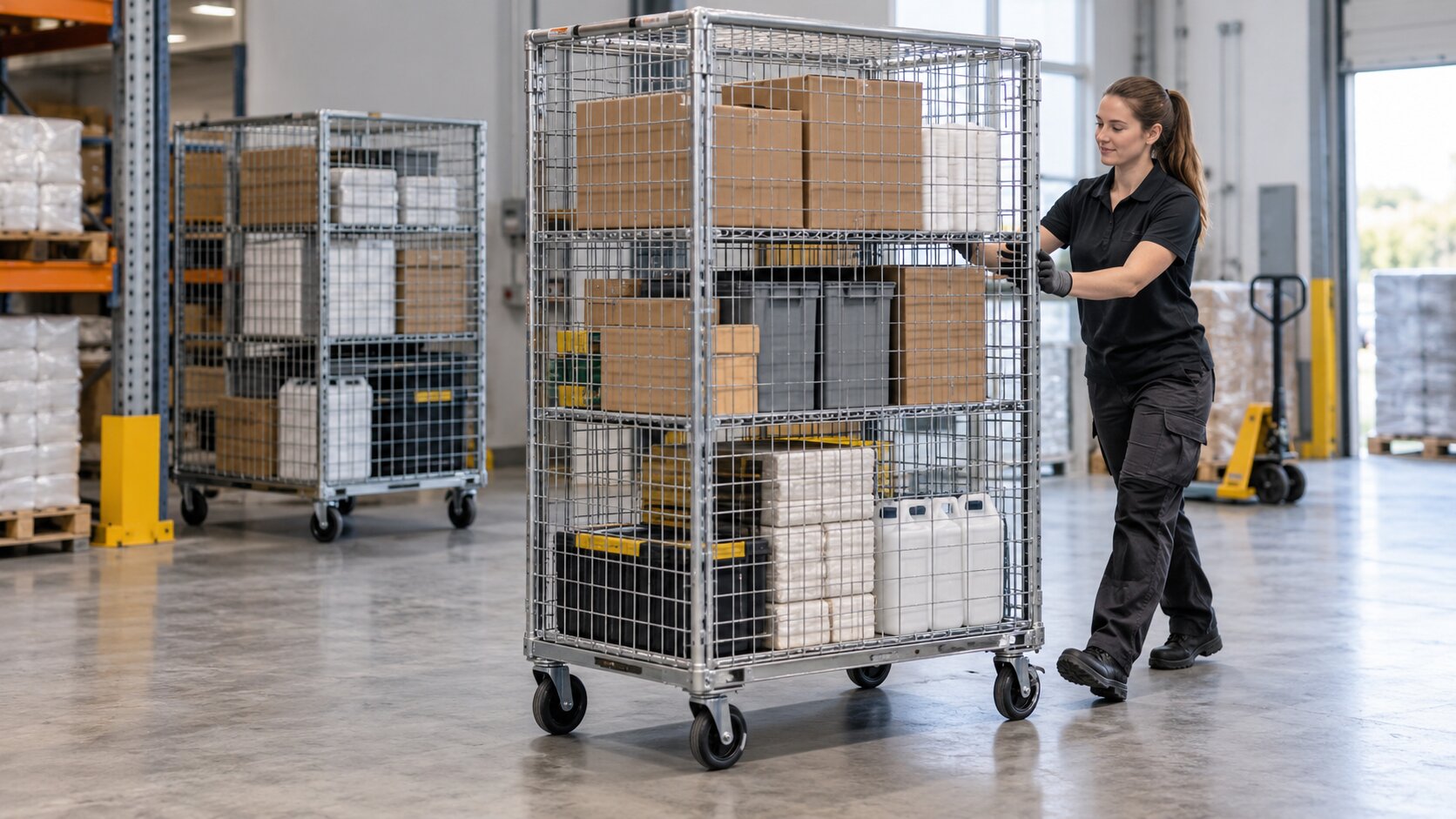
One-person operation. A cage loaded to 300–400kg can be moved by a single member of staff at push height, provided the castors are in good condition. This reduces the need for forklifts or pallet trucks for internal moves and cuts the manual handling injury risk associated with carrying.
Reduced double-handling. Goods loaded into a cage at the picking face stay in that cage until they reach the delivery point, whether that is the delivery vehicle, the shop shelf or the next production stage. Each additional handling step is a source of damage, loss and time cost.
Visible contents. Mesh or rod infill allows staff to identify the contents of a cage without opening it or unstacking the load. This speeds up stock checks, reduces errors in picking and makes it easier to locate specific goods in a busy stockroom.
Space efficiency when empty. Nestable A-frame cages fold flat when empty, stacking several units into the footprint of one. This matters significantly on return vehicle journeys and in storage areas where cage parking takes up floor space.
Secure transit. 4-sided and full security cages enclose the load entirely, preventing opportunistic access during transport. High-value stock stays contained from the picking face to the delivery point.
New or refurbished storage cages on wheels?
New units are the right choice when standardising a fleet for a new operation, when a consistent specification is required across multiple sites, or where hygiene or regulatory standards require certifiable condition.
Refurbished cages have been stripped, inspected and rebuilt with worn components — castors, hinges, mesh panels — replaced. A refurbished unit performs to the same functional standard as a new one and costs less. It is the practical choice for expanding an existing fleet or replacing individual units that have reached end of life.
Both options are available from our equipment sales page. If your operation needs advice on specification — cage size, castor type, 2-sided versus 4-sided — call 01279 883 286 and we will work through the options based on your load, environment and floor surfaces.
What to check before buying a storage cage on wheels
Load capacity (Safe Working Load). Every cage has a stated SWL. Overloading is the most common cause of frame damage and castor failure. Check the specification sheet for the specific unit, not a general estimate for the cage type.
Castor specification. The right castor depends on the floor surface and environment. 125mm 4-bolt fitting castors are the standard for most roll cages. For quiet environments — hospitals, hotels, retail sales floors — 160mm rubber castors run significantly quieter and handle surface transitions better. Braked castors are required on loading bays, slopes or where a health and safety policy requires cages to be immobilised when stationary.
Nesting or fixed-frame. Nestable A-frame cages are the right choice for operations that move cages on vehicles and need to manage return journeys efficiently. Fixed-frame cages suit static storage roles where the cage lives in one place and nesting is not a consideration.
Gate configuration. A drop-down gate is faster to operate for high-turnover picking. A swing gate gives better security. A removable gate provides full front access for loading awkward or large items.
FAQ
What is a storage cage on wheels?
A storage cage on wheels is a wheeled steel container used to move and store goods in warehouses, retail stockrooms, distribution centres and industrial facilities. It is mounted on four castors and has mesh or rod infill on some or all sides, with a gate or door for loading and unloading. The wheels allow a loaded cage to be moved by one person without a forklift.
How much weight can a storage cage on wheels hold?
It depends on the type and specification. Standard 3-sided A-frame roll cages typically hold 250–350kg. Full security 4-sided cages and laundry cages handle up to 500kg. Delivery and nestable cage trolleys are usually rated 150–250kg. Always check the stated Safe Working Load for the specific unit.
What is the difference between a storage cage on wheels and a roll cage?
The terms are used interchangeably. “Roll cage” is the most common term in UK retail and distribution for an A-frame nestable cage on wheels. “Storage cage on wheels” is a broader term that also covers fixed-frame cages, delivery cages and laundry cages. Both are wheeled steel containers — the difference is usually in the frame construction and whether they are designed for logistics cycles or static storage.
Do storage cages on wheels need maintenance?
Yes. The key components to check regularly are castors (spin freely, no flat spots, no seized bearings), gates and hinges (open and close without forcing, latch fully), frame integrity (no bent uprights, no cracked welds) and mesh or rod infill (no broken wires or bent rods). A cage with a seized castor or a misaligned gate is a manual handling hazard and should be taken out of service until repaired.
Can you repair storage cages on wheels?
Yes. Distribution Maintenance repairs roll cages, cage trolleys and storage cages at our facilities in Harlow and Grantham, and our mobile engineers attend sites across the UK. Common repairs include castor replacement, gate realignment, hinge replacement and frame welding.
Do you supply storage cages on wheels for healthcare?
Yes. For healthcare environments, we supply laundry cage trolleys with rod infill and non-porous bases that can be pressure-washed daily with standard industrial cleaners. Fixed-frame lockable cages are available for secure storage of equipment and controlled items.