Roll Cage Accessories: How Small Parts Improve Performance and Extend Fleet Life
Roll cage accessories are individual components — straps, shelves, castors, hinges, covers and ID plates — that improve how a roll cage performs in daily use. Replacing a worn castor or adding a retention strap costs a fraction of replacing a whole cage, yet the impact on efficiency, load security and fleet lifespan is significant.
This post covers the main accessory categories, what each one does, and when to use it.
What roll cage accessories are available?
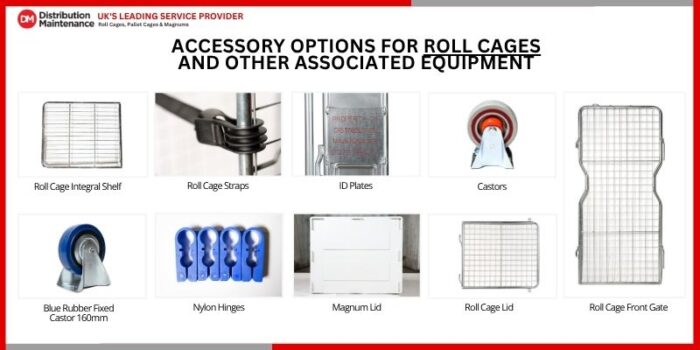
Distribution Maintenance supplies seven categories of roll cage accessories:
- DMA 1 — Roll cage integral shelf
- DMA 2 — Roll cage retention straps
- DMA 3A — Roll cage weatherproof cover
- DMA 3B — Roll cage internal liner
- DMA 4A–4H — Castors (six 125mm and two 160mm specifications)
- DMA 5 — Nylon hinges
- DMA 6 — Engraved ID plates
- DMA 7 — Magnum container lids
Each accessory addresses a specific operational problem — load shifting, access difficulty, floor noise, asset loss or component wear. Choosing the right combination for your fleet and your environment is the fastest way to improve day-to-day performance without replacing equipment.
How do roll cage accessories improve load security?
Roll cage accessories improve load security by keeping goods contained and stable throughout picking, transit and delivery. The two most important accessories for load security are retention straps and integral shelves.
Retention straps (DMA 2) clip into the mesh infill at any height and hold goods against the cage side, preventing shifting when the cage is moved or when the gate is opened at delivery. They are particularly important for mixed loads, ambient grocery and pharmaceutical distribution where a dropped or damaged item at the point of delivery has a cost.
Integral shelves (DMA 1) create a second tier inside the cage. Heavier items sit on the base; lighter or fragile items go on the shelf. This separation reduces pressure on lower goods and stops items from stacking in unstable configurations.
Front gates (DMA 9) and lids (DMA 8) fully enclose the cage and prevent items from falling or being accessed during movement between locations. These are particularly useful for multi-drop delivery routes where the cage is opened and closed repeatedly at each stop.
How do castors affect roll cage handling and safety?
Castors directly determine how much force is needed to move a loaded roll cage and how safely it can be steered. A cage with seized or worn castors requires significantly more push force — increasing manual handling injury risk and slowing down warehouse operations.
Distribution Maintenance supplies two sizes:
- 125mm castors (DMA 4A–4F) — the standard size for most A-frame roll cages, available in fixed, swivel and swivel-braked configurations in red/grey sandwich or white nylon/PP
- 160mm blue rubber castors (DMA 4G/4H) — larger wheels for environments where floor noise matters, such as hotel corridors, hospital wards or retail back-of-house areas; rubber wheels absorb vibration and run significantly quieter than nylon
Fixed vs swivel: Standard roll cage setup is two fixed rear castors and two swivel front castors. Fixed rear castors give directional stability on long warehouse runs; swivel front castors allow tight turns at the end of aisles.
Braked castors: Required on loading bays, slopes or anywhere a health and safety policy specifies that cages must be immobilised when stationary. A braked castor locks the wheel to stop the cage rolling when left unattended.
Well-maintained castors also reduce wear on the cage frame itself. A seized castor transfers load unevenly across the base — which eventually stresses the welds and frame uprights.
When should nylon hinges be replaced?
Nylon hinges (DMA 5) should be replaced when the gate does not fold back fully, catches during operation, or when the hinge itself is visibly cracked or broken.
Gate hinges take more stress than most other cage components. On an active cage, the gate is opened and closed hundreds of times per week. Nylon hinges are designed to handle this load — but they do wear, and a broken hinge left in place causes the gate to misalign, which puts stress on the gate frame and the latch mechanism.
Replacing a broken hinge takes minutes and costs a fraction of repairing gate frame damage that results from leaving it. For fleets running a quarterly maintenance check, hinge condition should be on the inspection checklist alongside castors and weld integrity.
How do ID plates help manage a roll cage fleet?
ID plates (DMA 6) help manage a roll cage fleet by giving every cage a permanent, readable identifier that survives the outdoor exposure, pressure washing and rough handling that printed labels cannot.
In multi-site or multi-operator supply chains, roll cages routinely end up at the wrong site, incorporated into another operator’s fleet, or simply unaccounted for. A durable engraved ID plate — attached to the front gate or top rail — makes it straightforward to identify ownership at any point in the supply chain.
Our ID plates are produced by our in-house industrial engraving service in stainless steel, aluminium, carbon steel or brass. They are not printed labels — the engraving is permanent and remains readable after years of outdoor exposure and regular pressure washing.
For fleets using Asset Performance Management (APM), barcode labels are used alongside or instead of ID plates to link each cage to its individual repair history and cost data in the APM dashboard.
What is the practical value of investing in roll cage accessories?
Roll cage accessories reduce four direct operational costs:
- Product damage — retention straps and shelves reduce load shifting; covers and liners protect goods from mesh contact and weather exposure
- Manual handling injury — well-maintained castors reduce the push force required to move loaded cages
- Equipment replacement — replacing worn hinges, castors and shelves costs less than replacing the cage; a maintained cage stays in service significantly longer than one left to deteriorate
- Asset loss — ID plates reduce the number of cages lost or misattributed in multi-site supply chains
Over a full fleet lifecycle, these savings are material. A fleet of 100 cages that each stays in service two years longer because of regular accessory maintenance represents a significant reduction in replacement capital expenditure.
How do I order roll cage accessories?
To order accessories or get pricing, use the accessories enquiry form on our accessories page, or call 01279 883 286. All accessories are available individually or in bulk — for high-turnover items like castors and straps, we can discuss volume pricing and scheduled deliveries.
If you need accessories fitted as well as supplied, our cage fitting and assembly service covers castor replacement, shelf and strap installation, and ID plate attachment at our facilities in Harlow and Grantham, or on your site via our mobile engineers.